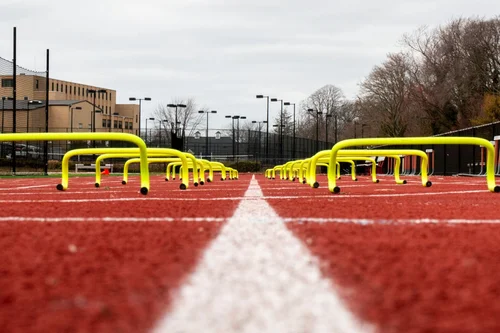
Wicket sprints
Wicket sprints involve running over a series of low obstacles, with one ground contact in each gap. Coaches use them to practise sprint rhythm, posture and foot placement.
Wicket runs: key elements & demonstration
Watch on Vimeo ↗A constraint with a purpose
Choose the running problem first. Set the wickets to create a manageable challenge. Judge the result through the whole run, including the exit and subsequent unrestricted sprinting.
A wicket is a small, low obstacle placed across the running path. In the sprinting task considered here, the athlete alternates legs and makes one ground contact in each gap. The obstacles encourage a particular pattern without requiring an instruction for every joint. This differs from jumping over hurdles, high knee stepping and practising a three step hurdle rhythm.

Match the running phase
Early acceleration, transition and upright sprinting place different demands on the athlete. A layout suited to one may obstruct another.
Fit the athlete’s speed
Choose spacing and height that allow the intended action. Look at approach speed, rhythm and posture together before changing a gap.
Check the free sprint
A fluent passage through the wickets is useful feedback. Look for a useful response without them, both immediately and on later occasions.
Why a coach might use them
Consider wickets when an athlete benefits from a clearer rhythm, a different movement experience or a simple external task that reduces the need for repeated technical instructions. They can also help you test a coaching hypothesis: does a slightly more compact step pattern help this athlete organise their contacts, and does that organisation remain when the constraint is removed?
The task can reveal a mismatch as well as create a useful response. An athlete who runs well freely but struggles in a particular layout may need a different layout. Completing the drill is not an obligation to preserve a poor setup.
Who this guide is for
The main examples suit ambulant adolescent and adult athletes who already tolerate the running speeds being used. Sprinters, hurdlers and jumpers may use the task within their speed development. Middle distance athletes may use selected versions for rhythm or speed, provided the purpose and load fit their programme. Wickets do not replace race hurdle practice, a jump approach or unrestricted sprint exposure.
For younger athletes, beginners and athletes with impairment related differences, begin with their own movement and confidence. Reduce obstacle height, shorten the task or use flat markers. Most direct studies involve small male samples; their settings should not become universal prescriptions for other populations.
The best setup is one you can explain, observe and adjust for the athlete in front of you.
Build the task around the running you want
Before moving a wicket, complete this sentence: “Today I want this athlete to practise…” Finish with an action or outcome you can observe. Examples include entering upright running without reaching, maintaining an even rhythm at a known speed or carrying a useful movement into a free sprint.
One run, three coaching opportunities
- 01 · Approach →Build to the speed and posture the task needs. Enter without chopping the last steps.Watch: the final approach contacts
- 02 · Wicket zone →Alternate legs, with one ground contact in each gap. Run through the spaces rather than jumping over barriers.Watch: rhythm, clearance and reaching
- 03 · Free exit →Keep running to a visible target beyond the final wicket. Allow a separate clear deceleration area.Watch: what continues without wickets
Explore wicket sprinting in 3D
Follow the approach, alternating contacts through the wickets and free exit. Use the demonstration to discuss the movement, then assess the athlete’s own running and response to the layout.
Open the interactive 3D wicket demonstration in a new tab
Acceleration and maximum speed need different tasks
Acceleration involves changing posture, step length and the way each contact contributes to increasing speed. Studies following consecutive steps show that the athlete’s geometry changes as acceleration develops. Upright running is part of that progression, rather than a position to impose from the first step. 67
| Purpose | Useful task design | What to assess | Main trap |
|---|---|---|---|
| Early acceleration | Free starts or flat, non slip markers related to the athlete’s observed early contacts. Allow the steps to open as speed builds. | Forward progression, effective pushes and a natural rise. Compare the start and acceleration split. | Raised obstacles can encourage premature recovery height or an early upright posture. Do not import an upright wicket pattern into the first steps. |
| Later acceleration and transition | A sufficient approach followed by a short sequence with gradually opening gaps, where this matches the athlete’s developing step length. | Smooth entry, continued acceleration and progressively changing posture. | A long final gap can make the athlete reach even when the first gaps fit well. |
| Upright mechanics practice | Low wickets at a manageable speed. Constant or modestly progressive spacing can be used according to the speed pattern. | Organised support and recovery, relaxed upper body and continuity through the exit. | Calling a controlled rhythm run “maximum speed” because it looks upright. |
| Maximum speed exposure | A sufficiently long approach, suitable low obstacles and a short zone that permits the athlete to retain high speed. | Actual speed, the quality of the contacts and subsequent free sprinting. | Counting a slower constrained run as equivalent to the athlete’s unrestricted maximum velocity exposure. |
| A familiar preparation activity | A small, previously tested dose before the main running task, followed by adequate recovery. | The athlete’s readiness and the quality of the following free efforts. | Assuming every wicket arrangement has a potentiating effect. |
| Rhythm within longer running | A short technical segment with a clear purpose; monitor its contribution to the whole repetition. | Whether rhythm remains useful as the athlete continues. | Using obstacles to force technique when fatigue is already disrupting clearance or control. |
Anderson’s teaching materials distinguish upright wicket work from tape drills for starts and acceleration. Research on flat markers has also examined later acceleration, with markers between 20 and 40 m. Neither establishes that raised wickets should be used immediately out of blocks. 154
Illustrative timing check: an athlete’s best comparable flying 10 m is 1.10 s. A 10 m section through wickets takes 1.25 s, equivalent to 88% of that reference speed. The run may still serve a technical purpose, but it is a different exposure. Compare the same distance with suitable entry conditions, and calculate relative speed as reference time divided by observed time. Avoid using a whole 100 m personal best to estimate local maximum speed.
What spacing changes, and what it cannot guarantee
Running speed equals average step length multiplied by step frequency over the same interval. A step goes from one foot contact to the next opposite foot contact. A full stride returns to the same foot and normally contains two steps. This guide uses step length consistently.
Step length and frequency interact. Athletes can reach similar speeds with different combinations, and a change that increases one may reduce the other. A wider gap does not itself produce more speed. 8
With one contact per gap, spacing approximates step length only when the athlete lands at a similar relative position in successive gaps. If the landing position drifts forwards or backwards, the two measurements differ. Wicket spacing is an environmental constraint, not a direct measurement of the athlete’s stride.
A more compact rhythm
At the same speed, shorter steps require a higher frequency. If that demand is excessive, the athlete may slow, shorten the push, take hurried steps or lose fluency. A modest reduction may be useful when you deliberately want to explore a more compact action.
Room to run through
The athlete enters without a major adjustment, maintains the intended speed and continues freely. This is a useful starting observation, not proof that one configuration is optimal.
A larger step demand
The athlete may meet the gap through more speed and effective support, or compensate with reaching, extra flight or a backward lean. Observe which solution appears. Simply clearing the next wicket does not settle the question.
These are possible responses and coaching interpretations. Spacing alone does not determine posture, joint angles or force production. Entry speed, athlete capability, height and instructions also shape the response.
In a separate experiment imposing step frequencies on 40 athletes, maximum speed was highest at the self selected frequency. Large imposed changes reduced speed, even though faster cadence shortened contact time. The study used a rhythm constraint rather than wickets, but it is a useful warning against judging a drill by quicker feet alone. 9
Keep ground support in the picture
The athlete must apply useful force while on the ground. At high speed, that includes supporting the body during brief contacts as well as managing the horizontal braking and propulsive parts of the step. An observational treadmill study linked faster top speeds to greater support forces; it did not show that a stamping cue or faster foot movements would improve an individual. 10
Early acceleration also needs enough time to produce the required impulse. Research in female sprinters associated different step and support characteristics with early acceleration and later running. This is another reason to avoid prescribing the shortest possible contacts throughout the run. 13
A useful posture is an organised moving posture
For upright running, observe whether the athlete carries the trunk and pelvis comfortably, supports their body during contact and recovers the leg without an exaggerated pause or reach. “Tall hips” can be a useful cue; it does not mean rigidly holding the pelvis, forcing the chest up or arching the lower back.
Pelvic movement is part of sprinting. A direct wicket study found altered pelvic rotation along with a change in step rhythm. That observation gives no reason to deliberately twist the hips or eliminate their movement. 1
Likewise, a high knee is only one frame in a continuous action. Research links thigh movement to running speed, while research specifically examining front and back side measures has not established a universal visual model that predicts faster sprinting. Use the picture to ask a better question, then check the running outcome. 1211
Choose height separately from spacing
Use low, forgiving obstacles, and select height according to the purpose and the athlete’s ability to run through them naturally. Flat markers remove the clearance requirement; raised wickets introduce it. That makes height a separate variable, even when every gap is unchanged.
One small study compared 0.5, 13 and 20 cm obstacles at the same 2.20 m spacing in 12 male sprinters and jumpers. The 20 cm condition reduced speed and step frequency compared with the almost flat condition. The middle height did not differ significantly from either. This supports checking the effect of height rather than automatically raising it. 2
Practical first trial: flat markers or flexible wickets around 5 to 10 cm high can make a forgiving introduction. Experienced athletes may use approximately 10 to 15 cm where clearance remains unobtrusive. These are coaching options, not validated age bands or mandatory progressions. Retain a lower height if it supports better running.
If the athlete jumps, tucks, stares down, lifts the hip sideways or repeatedly clips obstacles, lower them or remove them before demanding more effort. Avoid rigid improvised barriers, raised cone edges in the landing space and layouts that obstruct adjacent lanes. Secure a clear, even surface and enough space to decelerate gradually after the running exit.
Using cones as wickets
Cones offer a practical way to mark a wicket-style rhythm when dedicated wickets are unavailable. Use the video as an equipment example, then choose the spacing and arrangement for your athlete.
Keep the running task clear: alternate legs, aim for one ground contact between successive markers and continue running beyond the final marker. Adjust the layout if it prompts reaching, jumping or hesitant steps.
Check the equipment: cone height and base width change the clearance and landing space. Keep raised edges out of expected foot contacts. Where cones obstruct natural running, use flat markers or low, flexible wickets instead.
Watch on Vimeo ↗
Drawn lines as foot-placement targets
Drawn lines on the ground can provide target foot placements, serving a similar rhythm and spacing purpose to wickets without an obstacle to clear. Set the marks around the athlete’s running pattern and the purpose of the task, rather than asking them to match an arbitrary layout.
Watch where attention goes: trying to land precisely on each line may encourage the athlete to look down, altering the intended head and trunk posture or prompting reaching and hesitant steps. Treat this as a response to observe, rather than an inevitable effect of using lines.
Keep the athlete running: let them inspect the marks before starting, then direct attention towards a visible target beyond the sequence. If they keep checking their feet or adjusting abruptly to hit a line, simplify or change the marks, relax the precision demand, or return to free running. Compare the next unrestricted run to check whether the task helped.
Find the first spacing from the athlete’s running
- Choose the intended speed and phase. Use the same footwear, surface and approach planned for the wicket task. A spacing measured at top speed may not fit a controlled introduction.
- Film several representative free runs. Use a perpendicular side view with known ground distances. Select the section that matches the future wicket zone.
- Measure several consecutive steps. Measure between successive opposite foot touchdown locations along the direction of travel. Five step intervals require six touchdown events. Repeat across runs and look at left and right steps as well as the average.
- Lay out a short, manageable trial. For an even upright rhythm, begin near the observed step length. If deliberately exploring a more compact rhythm, a small reduction is an option. Start with six to ten low wickets so you can observe the entire sequence.
- Adjust one variable and reassess. Check approach and height before widening gaps. A change of a few centimetres may be sufficient; the important test is the athlete’s response, not the size of the adjustment.
For acceleration, preserve the sequence of changing step lengths. An average across the first ten steps hides that progression. Use unobtrusive flat markers to explore a pattern close to the athlete’s measured contacts, or retain free acceleration when marks make the athlete steer their feet. Do not prescribe an early acceleration pattern from the athlete’s height alone.
Published examples: useful reference points
| Source | Published arrangement | How to interpret it |
|---|---|---|
| Kadlec / ASCA | Approximately 1.52 to 1.98 m, selected according to athlete speed. | A practical demonstration range. It is neither a limit nor an optimal range for all athletes. 16 |
| Hettler / ALTIS practice | Approximately 1.68 to 2.29 m, with gaps increasing through the sequence. | An account of an individually adjusted progressive system. 17 |
| Holler | Eight wickets at fixed 1.83 m gaps. | One coach’s untimed practice arrangement; the task’s actual intensity still depends on how it is run. 18 |
| Ota et al., 2024 | 10 cm wickets at 95% of normal step length, placed within the 40 to 60 m section. | A small acute research comparison. It did not establish an optimal layout or long term programme. 1 |
| Makaruk, 2021 | 2.20 m gaps while obstacle height was varied. | A fixed experimental distance chosen to test height; not a recommended default. 2 |
Suggested starting decision: if you have no measurements, published ranges can help you set up a short exploratory lane. Use flat or very low obstacles, establish a manageable entry and watch several attempts. Measure the athlete as soon as possible. A gap being common in a chart does not make it appropriate today.
Constant or progressive gaps?
Explore a steady rhythm
Useful when entry speed is already close to the intended speed and step length is reasonably stable. It simplifies setup and comparison. If the athlete continues accelerating, the same gaps may become increasingly restrictive.
Allow a developing pattern
Useful when speed and step length are still increasing. Small changes can be made every gap or in short groups. The progression must fit the athlete; a widening line can become a reaching exercise if speed stops increasing.
For an illustrative nine wicket transition layout, eight gaps could be 1.50, 1.50, 1.55, 1.55, 1.60, 1.60, 1.65 and 1.65 m. This occupies 12.60 m between the first and last wicket. These numbers demonstrate how to build and record a progression; they do not define the correct setup for a particular age, sex or race time.
Neither system has established universal superiority. Keep the layout that creates the intended task with the fewest unwanted compensations, then reassess as speed, familiarity and conditions change.
The approach and exit are part of the drill
Allow enough approach to arrive at the intended speed without reaching or stuttering for the first wicket. For a controlled introduction, a relatively short build up may suffice. For higher speed practice, approximately 20 to 40 m is a practical starting discussion, with longer approaches sometimes needed by faster athletes. Determine the distance from observed running and timing rather than treating it as a guarantee of maximum velocity.
If the first gap causes a large adjustment, inspect the final approach steps. Move the start position or the whole wicket line slightly while keeping the gaps unchanged, or simplify the entry. Repeatedly moving one isolated wicket can create a new problem in the next gap.
Place a clear running target approximately 10 to 20 m beyond the final wicket when space and session purpose allow. Continue the intended action to that target, then decelerate in a separate clear area. Gomez describes comparable free running extensions in his coaching practice. 19
In groups, provide more than one layout where practical. Group athletes by how they currently run the task and adjust as needed. Height, sex, age and personal best may inform your thinking, but none independently determines the right gap.
Explore a wicket layout
Choose a purpose, find a starting gap from the athlete’s running, then use the first trial to refine the layout.
Your starting layout
Build from a measurement above, or use Fine-tune to explore your own layout.
Wicket detail · one contact per gap
Ready · first to last wicket.
Constant-speed illustration, not a prediction of acceleration or exact foot placement.
Drag a slider or use − / + to see what changes.
Top view at a fixed distance scale: larger gaps move the wickets farther apart. Scroll across longer layouts to inspect every wicket. Gold ovals, when shown, illustrate alternating contacts. They do not prescribe an exact touchdown location within each gap.
Understand the rhythm calculation
Record the whole layout, check the entry and leave a separate clear deceleration area beyond the running target.
Observe the approach, contacts and free exit. Change one feature, then compare another run after recovery.
Fine-tune the layout Gaps, wicket count, approach and exit
Track setup & every wicket position
The control ranges are for exploration. They are not recommended bounds. Progressive mode distributes the gap sizes between your first and last values, rounded to the nearest centimetre; it does not model acceleration.
| Wicket | Gap from previous | From first wicket | From start |
|---|---|---|---|
| 1 | Not applicable | 0.00 m | 25.00 m |
| 2 | 2.00 m | 2.00 m | 27.00 m |
| 3 | 2.00 m | 4.00 m | 29.00 m |
| 4 | 2.00 m | 6.00 m | 31.00 m |
| 5 | 2.00 m | 8.00 m | 33.00 m |
| 6 | 2.00 m | 10.00 m | 35.00 m |
| 7 | 2.00 m | 12.00 m | 37.00 m |
| 8 | 2.00 m | 14.00 m | 39.00 m |
| 9 | 2.00 m | 16.00 m | 41.00 m |
| 10 | 2.00 m | 18.00 m | 43.00 m |
Running target: 58.00 m from the start. Add a separate deceleration area.
Teach the task, then let the athlete run
Explain the purpose before giving a cue: “We are using the spaces to explore a flowing sprint rhythm, then checking whether you can carry it into open running.” Select one observable priority. Let the athlete complete the run before discussing it, and ask what they noticed. A knowledgeable coach can hold a detailed technical model without passing every detail to the athlete.
A small menu of useful cues
These are coaching options to test, not instructions every athlete needs. Retain a cue when the response serves the session goal and remains useful outside the wickets.
“Build in smoothly.”
Look for a progressive approach that arrives at a suitable speed without a last moment brake or stretch. If the athlete repeatedly searches for the first gap, review the approach and layout before asking them to concentrate harder.
“Tall and easy.”
Look for comfortable support through the hips and an available, coordinated trunk. Tall does not mean lifting the chest into an arch, locking the pelvis or eliminating its natural rotation. The athlete should still look able to sprint.
“Run through the spaces.”
The intention is continuous running with one contact in each gap, rather than a series of deliberate jumps over objects. Watch whether the athlete keeps travelling or starts organising each clearance separately. Lowering the obstacle may help more than another instruction.
“Step down and keep moving.”
Use this to discourage a searching reach. It does not require stamping, forcefully pawing backwards or placing the foot literally behind the centre of mass. Touchdown relationships change through acceleration; a useful cue should not become a rigid position rule. 6
“Let the arms run.”
Use when the athlete visibly braces the shoulders or holds an unfamiliar arm shape while negotiating the grid. Look for comfortable arm and leg coordination. A fixed elbow angle or perfectly still upper body is not the task.
“Carry the rhythm beyond the last wicket.”
Direct attention towards the open running zone. Observe whether posture, speed and coordination continue when the spatial prompts disappear. Make the run through the exit part of the repetition, rather than rewarding the final clearance as the finish.
Check the task before adding another cue
- Purpose, speed and entry: is this the intended running task, and does the athlete arrive at a speed that suits the layout? Watch the approach as well as the first gap.
- Spacing and height: does the layout create the problem? Inspect where disruption begins. Adjust one feature, keeping the rest comparable.
- Fatigue: has a previously fluent pattern deteriorated as the session progresses? Allow recovery or end the task when quality cannot be reproduced.
- Cue: if the task is suitable and the athlete is ready, try one short instruction. Compare the response with the previous attempts.
A cue hierarchy for common observations
After the task checks above, use this table to select one cue.
| Problem | First cue to try | If it persists | Avoid |
|---|---|---|---|
| Braking before entry | “Build in smoothly.” | Review the approach and first gaps at the intended entry speed. | Adding speed without checking the layout. |
| Reaching in later gaps | “Keep running through.” | Check whether spacing exceeds the athlete’s current pattern or speed is falling. | “Make your stride longer.” |
| Floating over every wicket | “Run through the spaces.” | Lower the obstacles and review spacing. | Rewarding clearance height. |
| Crowded, chopped steps | “Let the rhythm flow.” | Review spacing relative to entry speed; trial a small adjustment. | Assuming faster feet mean faster running. |
| Rigid trunk or exaggerated arch | “Tall and easy.” | Simplify the task and compare with free running. | “Lock your hips” or “chest higher”. |
| Pattern disappears at the exit | “Run on beyond the last wicket.” | Check anticipation of the finish; compare a separate free sprint. | Adding more wickets automatically. |
Observe the whole run and check what transfers
Begin with a free sprint at the intended task speed. This gives the coach and athlete a reference for their usual coordination. Observe the approach, entry, wicket zone and exit as one sequence. A good middle section can conceal a disrupted entry or an immediate loss of rhythm afterwards.
Assess whether the intended quality remains useful in free running, allowing step length and frequency to change naturally with speed and the removal of the obstacles. Transfer does not require preserving the exact wicket rhythm.
Follow the rhythm
Watch foot placement, flight, posture and continuity across several contacts. Position the camera perpendicular to the area being judged and far enough away to reduce perspective distortion. Include the transition out of the wickets.
Check the route
Look for lane drift, crossing steps or repeated avoidance of a wicket edge. Keep the camera safely outside the athlete’s route. Natural pelvic and trunk movement is expected; a visible asymmetry is a reason to investigate, not a diagnosis.
Check the response
Record comparable running times and ask whether the task felt flowing, crowded or forced. Neither appearance nor the athlete’s impression should stand alone. A quicker step rhythm can coexist with lower running speed. 9
A structured observation checklist
Use this to record a pattern and choose one priority. It is not a validated score, and there is no pass mark.
- Approach: the athlete builds speed progressively and follows a repeatable route.
- Entry: the transition occurs without a conspicuous brake, stutter or searching reach.
- Within the grid: contacts remain rhythmic, with no growing reach, crowding or exaggerated flight.
- Posture and coordination: the athlete maintains comfortable support without forced arching, bracing or held knee positions.
- Clearance: the athlete negotiates the obstacles without reorganising every step into a jump.
- Exit: running continues smoothly beyond the final wicket, without an immediate technical reset.
- Repeatability: the same response appears across several attempts, not just the best clip.
- Transfer: the intended change remains useful during comparable free running.
Use video for questions it can answer
Video at 120 or 240 frames per second can help identify contact events and follow a sequence. One frame represents about 8.3 or 4.2 milliseconds respectively. Selecting the first and last contact frames, motion blur and camera perspective all affect estimates. Small apparent differences should not drive a decision on their own.
Ordinary video cannot measure ground reaction force, tissue loading, muscle activation or injury risk. It also cannot establish that an athlete is “stiffer” because the heel appears to lower less. Use visible changes to form a question, then combine repeated observations, timing and athlete feedback.
Make the comparison fair
Use the same surface, footwear, timing zone, equipment and approach conditions. Record the layout and allow enough recovery for comparable efforts. Note meaningful wind changes. Compare several attempts rather than selecting the fastest wicket run and the slowest free sprint. If the measured zones or entry speeds differ, explain that difference before interpreting the times.
Check transfer twice: first during free running later in the same session, then at a subsequent session before reintroducing the wickets. An immediate response may be temporary. A change that remains available later is more useful evidence of learning, although it still does not isolate the wickets from the rest of the programme.
Two examples of coaching decisions
Fluent entry, awkward finish
An athlete enters comfortably but reaches through the final gaps. Check whether speed is falling, the later gaps widen or fatigue has developed. After recovery, adjust only the final spacing while preserving the approach. Compare continuity and the exit, then check a free sprint. Do not conclude from one clip that the athlete lacks strength or needs longer strides.
The pattern stays inside the grid
An athlete looks coordinated between wickets but changes immediately afterwards. Confirm they are running through the exit rather than preparing to stop. Try one continuation cue, then compare a separate free sprint at similar speed. If the change still disappears, simplify the task and reassess later. Success at clearing wickets has not yet demonstrated the intended benefit to free running.
Choose the variation that serves the athlete
The following options are coaching examples, not a sequence every athlete must complete. Select one task for a clear purpose, preserve enough unrestricted running to assess transfer, and change the arrangement when it produces a different movement from the one intended.
1 Low or flat familiarisation
- Objective
- Learn to enter, run through and leave the arrangement without looking down or preparing to jump.
- Setup
- Use six to eight flat strips or very low collapsible wickets. Start with gaps that fit the athlete’s comfortable running at the chosen speed. Provide an unhurried approach and a clear continuation area.
- Coach
- Ask for a smooth run towards a distant marker. Watch whether the final approach steps remain normal.
- Common errors
- Stuttering before the first obstacle, targeting every gap or exaggerating knee lift to demonstrate the drill.
- Regression
- Use fewer flat markers or remove the first obstacle while retaining the entry line.
- Progression
- Repeat with a slightly faster entry only when the pattern remains comfortable. Recheck spacing after changing speed.
2 Uniform upright rhythm
- Objective
- Explore an even rhythm during upright running, with enough speed to make the task relevant.
- Setup
- Use eight to twelve low wickets at equal gaps. Select the gap from the athlete’s observed running, then provide sufficient approach to arrive in the intended posture and speed range.
- Coach
- Look for continuity from entry to exit. A single cue such as “run through to the cone” may be enough.
- Common errors
- Reaching to preserve the gap, rushing small steps or slowing at the first wicket.
- Regression
- Reduce the obstacle height or shorten the series. Match the gap to the changed entry speed.
- Progression
- Retain the same arrangement while improving consistency or transfer. Wider gaps are optional. Fixed spacing is one established coaching approach. 18
3 Progressive transition
- Objective
- Connect a controlled entry to a gradually opening running pattern.
- Setup
- Use a short series with small increases between groups of gaps. Start from an observed pattern and record each gap, rather than spacing the equipment by eye. Progressive layouts are described by Anderson and Hettler. 15 17
- Coach
- Check that the athlete builds speed smoothly and rises naturally. The increasing gaps should remain compatible with the developing run.
- Common errors
- Standing upright prematurely, bounding into later gaps or assuming the layout itself guarantees acceleration.
- Regression
- Reduce the progression or remove the final group that produces the compensation.
- Progression
- Extend a successful pattern, or compare it with an unrestricted run after full recovery.
4 Wickets into a free exit
- Objective
- Check whether the useful movement continues once the obstacles disappear.
- Setup
- Place a visible continuation cone 15 to 20 m beyond a familiar wicket series, followed by space to decelerate gradually. Continuing beyond the wickets is an established practitioner method. 19
- Coach
- Observe the final three constrained contacts and the first three free contacts. Film both within the same view where possible.
- Common errors
- Stopping at the final wicket, abruptly reaching farther or holding an artificial drill rhythm in the open section.
- Regression
- Reduce the speed and number of wickets while retaining a free continuation.
- Progression
- After recovery, run the same overall distance without wickets. Compare the intended feature and performance, allowing natural changes in step length.
5 Acceleration with flat markers
- Objective
- Explore early acceleration without requiring the athlete to lift the feet over raised obstacles.
- Setup
- Observe several unrestricted starts first. Use their repeatable contact pattern to place a few flat reference marks alongside the lane. Keep the start type consistent.
- Coach
- Watch projection, progressive step development and continued acceleration. Use the marks to discuss the pattern, not demand exact foot placement.
- Common errors
- Looking down, reaching towards marks or copying another athlete’s contact distances.
- Regression
- Remove all but the reference needed for one observation, or return to an unmarked start.
- Progression
- Remove the markers and retest the start. Add a later wicket section only when its entry fits the athlete’s transition into upright running.
6 A familiar primer before free sprinting
- Objective
- Use a familiar task to focus attention before the main sprint work.
- Setup
- After the general warm up and progressive runs, complete one or two familiar wicket repetitions. Recover before the planned unrestricted sprint.
- Coach
- Select one relevant feature and ask whether it appears in the free run. Contrasting constrained and unrestricted practice is described by Behm. 20
- Common errors
- Adding so many drill repetitions that the main sprint loses quality, or treating a compact coordination drill as full speed running.
- Regression
- Use a shorter, easier sequence or omit the primer when the athlete already runs well.
- Progression
- Keep it only when repeated observations justify its place. A familiar primer does not guarantee an immediate performance improvement.
Adapt the task to the person
For younger athletes, introduce a short, simple pattern through confident running before adding precision or speed demands. For ambulant Para athletes, consider vision, balance, coordination, limb function and any prosthesis. Do not impose symmetry or another athlete’s gaps as a requirement. Where the obstacle creates an access problem, use an appropriate visual, audible or flat reference with the athlete’s input, or choose unrestricted running.
An example eight week development block
This example gives a coach a framework for learning, testing and gradually reducing dependence on the equipment. The fortnightly stages are planning windows, not a validated timetable. An experienced athlete may begin later; another may need longer at the first stage. Retain normal sprint training throughout.
| Stage | Practice emphasis | Coach records | Progress when… |
|---|---|---|---|
| Weeks 1 and 2 | Observe free running. Introduce a short low or flat arrangement and establish a reliable entry. | Gap pattern, approach, surface, footwear and the athlete’s response. | Entry and clearance are comfortable across several attempts, without obvious preparation to jump. |
| Weeks 3 and 4 | Refine one purpose using either uniform or progressive gaps. Change one variable at a time. | The intended change, video and relevant running speed. | The adjustment produces a reproducible response without sacrificing the session’s running objective. |
| Weeks 5 and 6 | Emphasise the free exit and separate unrestricted comparisons. Retain full recovery. | What persists beyond the wickets, performance and athlete feedback. | The useful feature is also evident without the constraint, across more than one session. |
| Weeks 7 and 8 | Use the smallest familiar dose that remains useful. Reassess the original problem. | Free sprint outcomes and whether wickets still add value. | The coach can retain, modify or remove the drill for a clear reason. |
Three session menus to adapt
Controlled skill session: try two to four short repetitions after warming up, with roughly two to three minutes between runs as an initial allowance. Use a comfortable speed and an easy arrangement. Extend recovery whenever needed to reproduce the task. This session explores coordination; it does not demonstrate maximum speed exposure.
Maximum speed session: begin with a complete sprint warm up, then try three or four high quality repetitions using an adequate approach, a suitable wicket zone and a free exit. Initially allow around four to six minutes between attempts, and longer for athletes who need it. Include an unrestricted comparison within the planned sprint volume. Check speed when maximum velocity is the objective.
Acceleration session: prioritise the planned starts and their performance measure. If markers answer a specific question, use them for two or three attempts within that session, then return to free starts. Raised wickets are not required. A separate upright wicket task is optional and must fit the remaining workload.
Count the approach and exit
A 25 m approach, an 18 m wicket zone and a 15 m free exit make a 58 m repetition. Four repetitions total 232 m, before the additional deceleration distance. Record the parts separately when useful, but include the whole run when planning the session. Do not count only the distance occupied by the wickets.
Keep the work useful as competition approaches
Begin with one purposeful exposure within an existing sprint session each week. A second may be useful if the athlete’s response and total programme support it. These are planning suggestions, not an established optimal frequency. When wickets are run fast, count them within the high speed work and preserve the athlete’s normal recovery between demanding sessions. An untimed drill in trainers can still be demanding.
Introduce unfamiliar arrangements during periods that allow time to observe and adjust. In competition weeks, favour a small, familiar exposure if it helps the athlete prepare. Avoid introducing demanding spacing or a novel arm restriction simply to make the final session look different.
Pause the sequence when entry becomes hesitant, contacts repeatedly clip obstacles, the athlete starts reaching or jumping, or speed and execution deteriorate across attempts. Allow recovery and reassess the setup. End the task if quality does not return. Stop a painful repetition rather than asking the athlete to solve it by trying harder.
What the evidence supports, and what remains a coaching decision
There is direct research on mini hurdles and flat markers. It supports a more specific conclusion than “wickets work”: particular arrangements can change the running task and sometimes influence the next sprint. Evidence for lasting improvements in trained track athletes is more limited, and the studies do not all investigate the same exercise.
What changed?
Look for the actual height, gaps, entry, participants and outcome. A compact stepping drill and a fast upright wicket run can both be called mini hurdle training.
Why might it matter?
Sprint studies help explain phase differences and movement relationships. An association does not establish which wicket prescription improves them.
What is worth trying?
Experienced coaches provide useful methods and hypotheses. Their systems still require individual observation and testing.
Direct studies worth knowing
| Study | Design and finding | Coaching implication and limit |
|---|---|---|
| Ota et al., 2024 1 | Twelve male sprinters. The individually shortened wicket condition increased frequency and shortened steps; speed did not change significantly. | Changing coordination does not necessarily change speed. This was an acute comparison with different start positions and a fixed trial order. |
| Makaruk, 2021 2 | Twelve male sprinters and jumpers. At fixed gaps, the highest obstacles produced slower speed and lower frequency than the almost flat condition. | Height changes the task. The small acute study did not establish an optimal height or assess training adaptation. |
| Yoshimoto et al., 2016 3 | Ten male sprinters in a crossover study. After a compact mini hurdle task, maximum sprint speed increased by 3.2% and frequency by 3.3%. | The task used 22 cm obstacles at only 0.90 m gaps. This was acute preparation work, not a test of normal race speed wicket spacing or long term improvement. |
| Saito et al., 2021 4 | Ten male sprinters. Flat markers at 90% of usual step length occupied the 20 to 40 m section. The next free run improved that section’s speed, but overall 50 m time did not significantly improve. | A local change and a whole sprint improvement are different outcomes. Fixed trial order and immediate testing limit the inference; it does not test the first steps out of blocks. |
| Kageyama et al., 2021 5 | Seventeen male baseball players completed four weeks of mini hurdle or sprint training. The hurdle group improved more on average, but the between group result was only a statistical trend at p < 0.10. | The drill used 50 cm gaps. Different participants and training volumes, plus uncertain group differences, limit claims about superiority for track sprinters. |
The very short gaps in the preparation and baseball studies describe different coordination tasks. They are not suggested spacings for sprinting at maximum velocity. None of these studies establishes a universal spacing chart or shows that wickets should replace unrestricted sprinting.
Related research: use it to sharpen the question
| Evidence | Useful interpretation | Avoid concluding |
|---|---|---|
| Acceleration mechanics | Studies in male and female sprinters show that useful step and support characteristics depend on the phase. 6713 | One posture, gap or contact time should be enforced from the start to maximum speed. |
| Step length and frequency | Different combinations can produce similar speeds. A large imposed rhythm change can reduce speed. 89 | The longest possible step or fastest possible cadence is always best. |
| Ground support and swing | Ground support and coordinated limb movement both deserve attention. Studies investigating either component do not validate a particular wicket drill. 1012 | A short contact, forceful stamping action or held high knee proves better sprinting. |
Does “front side mechanics” explain the benefit?
The phrase describes leg movement in front of a reference line through the body. It can help a coach discuss the action, but it is not a single, universally validated performance criterion.
Haugen and colleagues found no significant association between their measured front and back side variables and maximum velocity in 24 competitive sprinters. This challenges a universal visual prescription; it does not show that an individual athlete cannot benefit from technical work. 11
Mendiguchia and colleagues found changes in posture and sprint performance after a six week programme in 15 amateur male athletes. The intervention combined several training and therapy elements, so the benefit cannot be assigned to wickets or one cue. It also did not establish reduced injury incidence. 14
Coaching decision: use an observable movement goal for a reason, then assess the athlete’s performance and response. Avoid making knee height, a rigid pelvis or the absence of all movement behind the body a pass or fail test.
Where experienced coaches may reasonably differ
| Choice | Potential value | Potential limitation |
|---|---|---|
| Fixed or progressive gaps | Fixed gaps simplify a steady rhythm. Progressive gaps can accommodate a developing pattern. | Fixed gaps may restrict ongoing acceleration; widening gaps may force reaching. Published practitioner methods include both. 1718 |
| Short or long approach | A short approach can simplify familiarisation. A longer one can permit greater speed. | Neither assures an appropriate entry. More approach can expose a spacing mismatch rather than solve it. |
| Compact or natural rhythm | A modest constraint can create a different movement experience. A less restrictive setup may better preserve speed. | Task success may not transfer. Compare the free sprint and the athlete’s response. |
| Technical practice or speed exposure | Both can have a place when the purpose is clear. | The session label cannot determine its intensity. A fast drill still contributes meaningful sprint load. |
| More instruction or more task adjustment | A clear cue may focus attention. An equipment adjustment may solve the problem with less conscious control. | Too many cues can obscure the priority; an ill fitting environment can keep provoking the unwanted action. |
There is no strong comparative evidence establishing one complete wicket system as best for all athletes. Consider what each choice affords, what it restricts and what evidence you need to retain it for this athlete.
Four different claims to keep separate
- Task response: the athlete runs differently inside the wickets.
- Immediate transfer: the next unrestricted run changes.
- Retention: the useful response remains available later without reminders or equipment.
- Performance development: sprint outcomes improve over time within the athlete’s programme.
Evidence for one level does not automatically establish the next. Pair your observations with repeated, comparable performance measures and the athlete’s experience. There is no need to keep a drill that has stopped helping.
Choose a purpose, build a suitable task, observe the response and test what remains when the wickets are gone.
This is a practical narrative synthesis of selected original studies and practitioner accounts, not a systematic review. The example layouts, session menus, decision sequence and eight week plan are editorial coaching tools. They have not been validated as a complete intervention.
Wicket Bounds
Wickets can also shape a different movement task. Deliberately extending the gaps can encourage athletes to bound from one foot to the other, covering more ground with each effort.
Make the intention explicit: here, the aim is bounding with greater distance and flight between contacts. This differs from the sprinting task described above, where gaps should allow the athlete to run through without being forced to reach or jump.
Build from the athlete’s ability: begin with comfortable alternate-leg bounds, then position low, forgiving markers to suit the distances they can cover with control. Increase gaps only while they can land securely and move into the next bound without pausing or stretching the foot forward to reach a marker.
Use this as a separate bounding activity within the session. The sprint-layout calculator and sprint-rhythm examples above are not prescriptions for bounding.
Watch on Vimeo ↗